

DCS WORLD NEWSLETTER 13.11.2026
14 nov 2026 •
DCS World - Eagle Dynamics
DCS WORLD NEWSLETTER 13.11.2026
DCS: Balkans Development Report
An Update from OnReTech

Last November, we announced DCS: Balkans, a major terrain module covering the Balkans, the Adriatic Sea, and Italy’s Adriatic coast. This week, the OnReTech team reports on the progress they’ve made and outlines the map's full scope.
From the OnReTech team:
It’s been an exciting year for the team, and we’re happy to share where DCS: Balkans stands today.

DCS: Balkans covers the Balkan Peninsula and Italy’s Adriatic coast, letting you simulate the extensive air and ground operations across the region between 1991 and 2001. We’ve designed the map to support historically accurate sorties for both NATO and Yugoslav forces.
The playable area covers an impressive 1,200 by 1,000 kilometers, including Italy, Serbia, Croatia, Bosnia and Herzegovina, Montenegro, Kosovo, and North Macedonia, with additional coverage into Austria, Albania, Hungary, and Romania.

We’ve also hit a big milestone: 43 primary airbases have been modelled and are now in active testing. These include major strategic hubs such as Aviano Air Base in Italy, Split in Croatia, Sarajevo in Bosnia and Herzegovina, and Batajnica in Serbia.
We’re making steady progress toward Early Access, currently targeted for Q1 2027. To ensure you have plenty to fly from day one, we’re collaborating with partner teams on dedicated campaigns that will be ready at launch. Stay tuned for more details in our next update.

Thank you for your ongoing support. We can’t wait to see you in the skies over the Adriatic.
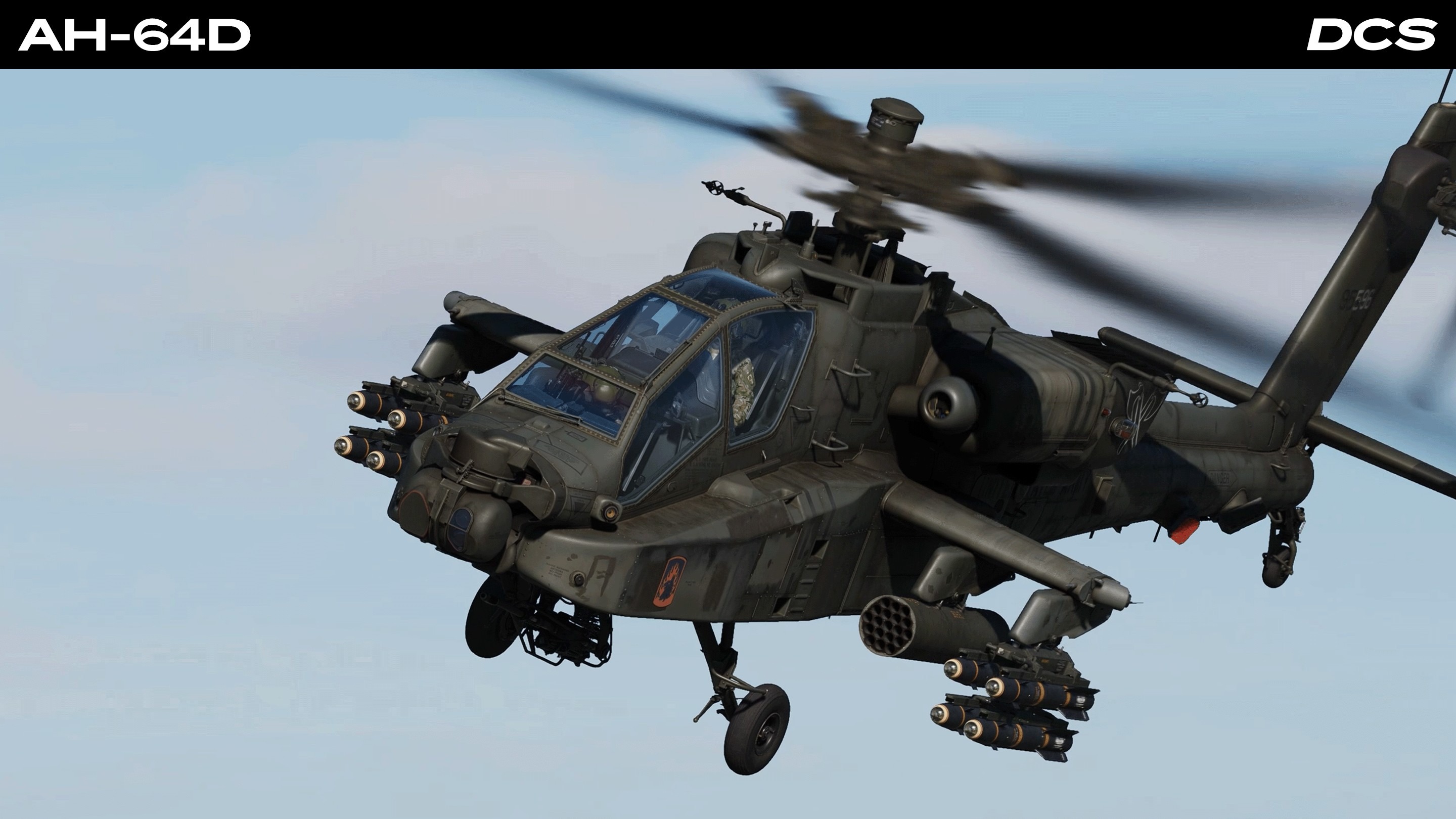
DCS: AH-64D Development Report
DCS: AH-64D Flight Model Development Report
After much anticipation, the refined DCS: AH-64D flight model is nearing release. This update will feature a more advanced and entirely new simulation of the helicopter's main rotor; a culmination of thousands of hours of tireless work by our flight dynamics team and regular feedback from several real-world AH-64D pilots. Below are bullet points summarizing the key refinements to the core flight model and the SCAS (Stability/Command Augmentation System) logic within the DCS: AH-64D's Flight Management Computer (FMC). These bullet points don't capture the full scope of the changes, as the rotor simulation work went far deeper than we can cover here.
In March of this year, we mentioned the following:
-
The exaggerated left yaw offset in forward flight has been reduced to a realistic magnitude.
-
We fixed the uncommanded left roll during cyclic push-overs in forward flight.
-
Stabilator logic has been refined, improving pitch stability in forward flight.
-
Rotor disc tilt and rotor coning have been improved to a more realistic behaviour.
-
The conservation-of-angular-momentum effect from forward/aft cyclic inputs has been refined.
-
Added the transient torque effect from left/right cyclic inputs.
-
Autorotation behaviour has been improved.
-
The drag profile more accurately accounts for external stores and the presence or absence of the FCR mast-mounted assembly, resulting in a 15% average increase in top speed.
-
We've slightly reduced fuel flow values to a more realistic level.
In the months since that previous announcement, we've implemented the following:
-
The helicopter's performance now matches the PERF page predictions (within a 3% margin of error) across the flight envelope.
-
We increased SCAS rate damping to improve stability when the Force Trim Release is not pressed.
-
SCAS no longer over-amplifies pitch, roll, and yaw inputs when the Force Trim Release is not pressed.
-
Yaw damping is disabled in forward flight, allowing Turn Coordination logic to function correctly.
-
Damage to the rotor system is now possible if VNE is exceeded (the phenomenon of main-rotor blade flutter—which inevitably begins to manifest under transonic and supersonic flow conditions—has been implemented).
-
Damage to the drivetrain components is now possible if torque limitations are exceeded over a sufficient duration and/or magnitude.
-
Vibration and audio effects have been added for transverse flow, high-speed flight, and increased G-loading to improve perception of the helicopter's aerodynamic state.

As each major iteration of the flight model reached a review-ready state, we evaluated over 700 data points of engine power, torque, and fuel flow across a range of variables, including airspeed, pressure altitude, air temperature, and gross weight. These tests included evaluations of the helicopter's hover performance in and out of ground effect, cruise performance, and maximum performance under single- and dual-engine conditions. However, these data points covered only static conditions for evaluating the foundational relationship between engine power and rotor drag. We also conducted hundreds of hours of additional test maneuvers to evaluate the rotor's dynamic behaviour, ranging from basic maneuvers to aggressive break turns, pitchback turns, pushovers, high-speed dives, high/low-G flight, and autorotations
(*to date, 206 internal test tasks have been completed, covering the new main rotor model, the helicopter’s SCAS, and its powerplant/transmission).
The latest entry within the AH-64 Mini-Update thread provides additional details regarding some of these refinements. We are confident this next update will deliver the most realistic and authentic AH-64D flying experience in the simulation market, and we're eager to get this new flight model to you in the nearest future.
DCS: AH-64D Flight Model Evaluation
Since the first days after the DCS: AH-64D Early Access release, fellow DCS player BradMick has posted instructional videos covering helicopter aerodynamics, basic maneuvers, piloting techniques, and emergency procedures. You can find these videos in his AH-64D Flight Lessons YouTube playlist.
BradMick is a former U.S. Army instructor pilot with over 3,500 flight hours in the AH-64D and AH-64E, and this week he shares his thoughts and personal assessment of the new flight model for DCS: AH-64D.
DCS: UH-1H Sentry Pacific: Island Tours Campaign
A New Campaign by SOB Simulations

From the creator of the DCS: F-16C Sentry Pacific 2025 and DCS: A-10C II Sentry Pacific ‘26 - One Last Ride campaigns, SOB Simulations brings you Island Tours for the DCS: UH-1H. It’s expected to arrive with the next DCS update.
You won’t dodge missiles or fly behind enemy lines this time. Instead, you’ll spend two weeks as Chief Pilot for Island Tours, a small Guam helicopter charter company that has landed a lucrative military contract supporting the massive Sentry Pacific exercise. Your job is to transport VIPs, haul cargo, ferry maintenance crews, support logistics operations and, now and then, wonder how your life choices led you here.
You won’t be flying alone. Riding shotgun is Skip: your retired Air Force copilot, self-appointed island historian, professional smartass, and firm believer that every radio call is a chance to entertain someone, whether they asked for it or not.
Across 11 hand-crafted sorties and more than 4.5 hours of professionally recorded voice-over, you’ll see the Sentry Pacific story from a completely different angle. Missions weave alongside the F-16C and A-10C II campaigns, expand familiar storylines, reveal what was happening behind the scenes, and tie all three campaigns into a single shared timeline. You might give aerial tours of Guam, sling-load cargo through tropical rain showers, or fly admirals with unrealistic expectations. Either way, every sortie plays like another episode of your favourite TV series.
Three campaigns. One timeline. One very opinionated copilot.
The DCS: UH-1H Sentry Pacific: Island Tours Campaign will be priced at $14.99 USD and is expected in the next DCS update. It requires the DCS: UH-1H and the free DCS: Marianas map.
Simulatori
- Falcon BMS
- East Mediterranean Front Theater
- IL-2 Sturmovik
- DCS World - Eagle Dynamics
- DCS: F-16C Viper
- DCS: Ka-50 Black Shark
- DCS: A-10C Warthog
- DCS: P-51D Mustang
- DCS: MIG-21BIS
- DCS: F/A-18C Hornet
- DCS: Combined Arms
- Microsoft Flight Simulator
- Altri simulatori
Reparti AMVI
- SMAV
- Comando Squadra Aerea
- Comando Scuole
- Reparto Affari Generali
- Reparto Sperimentale Volo Virtuale
- Gruppo Falcon
- Gruppo Hornet
- Gruppo IL2
- Gruppo Black Shark
- Gruppo Warthog
- Gruppo Radar
- Accademia
- RACSAV
- Vola con AMVI