

DCS WORLD NEWSLETTER 30.10.2026
31 ott 2026 •
DCS World - Eagle Dynamics
DCS WORLD NEWSLETTER 30.10.2026
Halloween Sale and DCS Update 2.9.31.29434
Updates and Saving in the same week!

Halloween Sale 2026
The Halloween Sale 2026 is now live on Steam and the E-Shop until November 8th at 15:00 GMT. Don’t miss the great prices offered on all our modules, maps, and campaigns. If there's a module that's been haunting your wish list, there's never been a better time to bring it home. Visit the E-Shop or DCS on Steam before the sun sets.
DCS: Su-25T Operation Red Storm Campaign by Ugra Media
First announced in September, Ugra Media's Operation Red Storm is now available. Set in Germany in 1984 on the DCS: Cold War Germany map, it puts you in the cockpit of a Su-25T as the 357th Separate Assault Aviation Regiment in a fictional conflict in the Fulda Gap that escalates across Central Europe. Over 18 missions and more than 10 hours of flying, each mission's outcome shapes what follows, and two bonus TF-51D racing missions over Hamburg and Berlin offer a fun pure flying break from the stress of frontline action.
DCS: F-14B(U) Speed & Angels Campaign by Reflected Simulations
Speed & Angels, created by Reflected Simulations with former Tomcat pilot and F-5 bandit Commander Paco Chierici, gets an update for the DCS: F-14B(U). It requires the DCS: F-14B(U) Tomcat, DCS: Supercarrier, DCS: Nevada Test and Training Range Map, free DCS: Marianas Map, and free DCS: Caucasus Map. If you are missing one of those components, just hop over to the store and pick it up at a big discount.
Core updates, AI behaviour, and Weapons
A large number of fixes, enhancements and tweaks address issues with damage models, especially for helicopters!
AI aircraft behaviour improvements address some of the problems marked by the community (including sporadic E-2D carrier-landing issues and F-4U carrier issues).
AI piston aircraft fuel consumption in low-RPM regimes was adjusted to reflect real-life parameters more accurately. Some fighters' gun tracers changed colour.
The Kh-22 now has the correct smoke colour and a contrail, along with a slightly less steep terminal trajectory, and the C-802 and CM-802AKG missiles have been adjusted to a smaller and more realistic radar cross section. Mission Editor now has a main game settings button, and scripting events were corrected to address coalition attribution problems and S_EVENT_KILL issues.
New Ground Units
Mission makers have eight beautiful new Currenthill ground units which have been added the free Currenthill Assets Pack. The ZTQ-15 light tank and BMD-2 IFV join the armour, the Ural Typhoon and AMN-2 Atlet bring two new MRAPs, and air defence gets the PGZ-09 SPAAG and a Ural 4320 carrying a ZU-23-2 anti-aircraft gun. Rounding things out are the ZIL-131 truck and the ZIL-131 Kung command vehicle.
Modules
The AEKRAN on the DCS: MiG-29A Fulcrum no longer shows a blank failure page on engine shutdown. The R-60 and R-60M missiles now reliably receive target designation, and COURSE/CMPTR ZERO during an RSBN correction no longer corrupts the autonomous navigation solution.
On the DCS: F/A-18C, the pilot's salute gesture in the cockpit view now works when the aircraft doesn't start on the catapult.
The DCS: AH-64D no longer crashes when sending a route over datalink. The APU now starts at high altitude; INU position confidence no longer breaks a minute or two into a mission, and flight symbology errors when GPS isn't available have been fixed.
The DCS: JF-17 Thunder by Deka Ironwork Simulations can now use the TDC on the HSD to control the radar scan and lock contacts, and tankers now disconnect properly once the JF-17 is fully refuelled.
IndiaFoxtEcho Visual Simulations' DCS: MB-339A/PAN adds a Ground Configuration menu, new communication menu controls, and separate PTT controls for SRS, along with fixes for the glide slope pointer, the HDG and CRS axes, external fuel tank refuelling, master arm polarity after landing, and the rocket training mission.
OctopusG's DCS: La-7 gets an updated cockpit pilot model, expanded Caucasus Quick Mission scenarios, and the first stage of its radio functionality, which is still a work in progress. Mission makers, please note: in the Mission Editor, set the radio frequency for all La-7 flights in your missions to between 3.7 and 6.06 MHz.
Campaigns
Reflected Simulations has updated the skins in several of its WWII campaigns, including the correct shade of blue nose for DCS: P-51D Blue Nosed Bastards of Bodney, fixed formations in DCS: P-47D Eagles Rising, and re-enabled formation takeoffs in DCS: F-4E Red Flag 81-2. Campaigns from Fight's On Simulations, Sandman Simulations, Apache600, Baltic Dragon and Whipbird Productions, and Badger633 also received fixes.
This covers the highlights in the current update. For every change, see the changelog here.
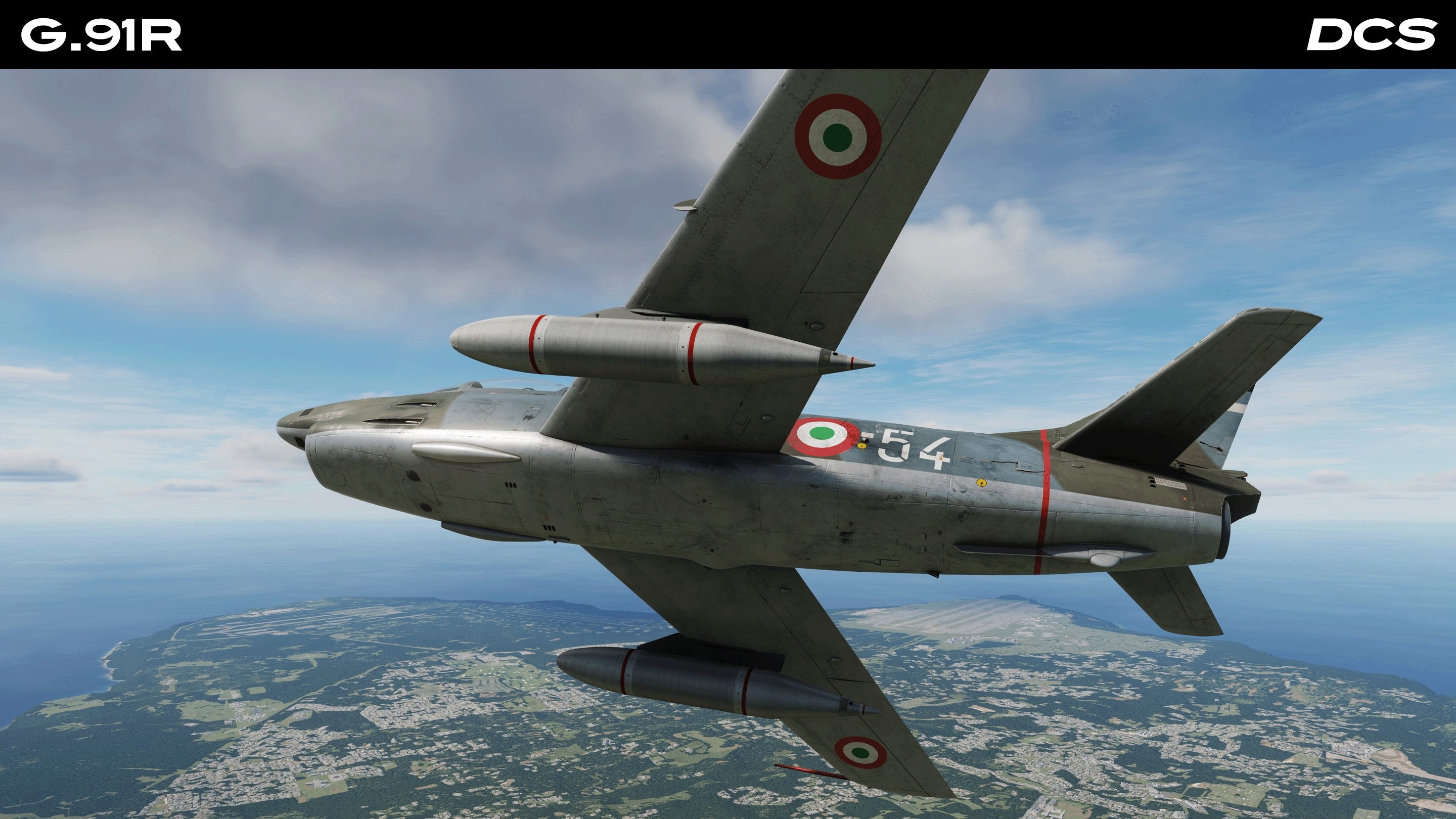
DCS: G.91R Development Report
Analog Navigation, System Damage, Pilot Physiology and Flight Model Improvements

Development of the DCS: G.91R continues to progress steadily as we bring the aircraft closer to its real-world counterpart. Our recent work has centred on the navigation equipment, the way the onboard systems interact, pilot physiology, and further refinements to the flight and engine models. Together, these developments are bringing out Gina's character, from the procedures needed to operate its analogue instruments to the challenge of handling the aircraft in demanding flight conditions.
PHI Navigation System
We've made considerable progress on Gina's navigation equipment, particularly the PHI system and its integration with the DRA-12 Doppler radar and the WIND UNIT. Unlike modern navigation systems, the PHI asks pilots to take an active role in managing their position and navigation data. It uses a series of preselected stations and Doppler radar information to support its navigation calculations. Pilots can also enter wind data manually through the WIND UNIT, so they can keep navigating when Doppler information is unavailable or unreliable.
We've spent a lot of time reproducing the original equipment's operating procedures and characteristics, including position corrections with the HOLD function, calculation delays shown by the SEQUENCE light, magnetic variation settings, bearing indications, and mechanical distance counters. The PHI also works alongside the J-2 gyromagnetic compass, giving pilots the instruments they need to navigate with the technology of the time. We're also refining the initialization procedures, so the navigation equipment behaves correctly for the mission configuration and the aircraft's starting conditions.
One interesting addition is TACAN. According to the technical documentation available to us, the TACAN was listed as inoperative, although the aircraft already had provisions for its installation. Even so, we've decided to integrate a functional TACAN system into the module, so pilots familiar with this type of equipment can enjoy Gina with a system they know and appreciate. It adds flexibility while keeping the original navigation equipment and its operating characteristics intact.
The end result is a navigation suite that demands more than just clicking a waypoint. You’ll need to know your equipment, follow proper procedures, and keep tabs on your position throughout the flight, just like the real Gina pilots did.
AD.722 Automatic Direction Finder
Another important milestone is completing Gina's AD.722 Automatic Direction Finder (ADF). Operating from 200 to 1,700 kHz, it lets pilots tune in to Non-Directional Beacons (NDBs), identify stations by their Morse code signals, and read their relative bearing from the cockpit indicator.
The implementation goes beyond basic beacon tracking. A dedicated radio propagation model accounts for distance, altitude, terrain, weather, and differences between daytime and nighttime propagation, as well as the different characteristics of signals travelling over land and water. As a result, reception quality and bearing stability vary with conditions, and weak or disturbed signals can give less reliable indications, so pilots will need to interpret the instrument rather than follow a perfectly steady needle.
With the AD.722 in place, Gina gains another important part of its original navigation equipment, particularly useful on cross-country flights and in operations where radio navigation remains the main means of orientation. Together with the PHI and Doppler equipment, the ADF gives a more complete picture of the navigation techniques used by pilots of this generation of aircraft.
Damage Model and System Failures
Work on Gina's damage model has moved beyond structural damage, with more attention now on what happens to the aircraft's systems after a hit. We're developing a more interconnected model in which failures can affect several systems, depending on the damage's location and severity. Areas being addressed include engine and air intake damage, fuel leaks, electrical and hydraulic failures, and the loss of flight control assistance, along with malfunctions affecting the landing gear, brakes, and flight instruments.
These failures aren’t just for show; they’ll have real consequences in flight. Damage to one system can ripple through others, leaving you with reduced performance, limited system availability, or trickier handling. For example, hydraulic damage can impact any equipment relying on hydraulic pressure, electrical failures might knock out your instruments, and fuel system issues can bring their own set of headaches, all depending on what’s hit and how hard.
We're also developing support for failures set up in the Mission Editor so that mission creators can introduce specific malfunctions and emergency scenarios. We aim to make damage and system failures an important part of the flying experience, rather than isolated events. You may find yourself managing an aircraft that can still fly, but no longer behaves or operates as expected. Testing continues, particularly on how system failures interact with their visual representation in DCS.
Pilot Physiology and Injury Effects
Alongside the aircraft's damage model, we've been working on the human side of combat damage, bringing pilot injury and sensory impairment into the simulation. Rather than treating a wounded pilot as simply alive or incapacitated, the model is intended to show how injuries can affect the pilot's ability to stay aware of their surroundings and keep operating the aircraft.
A wounded pilot may experience reduced sensory awareness, making it harder to monitor the instruments, maintain situational awareness, and respond to changing flight conditions. That adds another challenge, especially when an already damaged aircraft needs careful handling and quick decisions. Where appropriate, the implementation uses DCS's native effects, so the consequences of an injury are conveyed through the simulation itself rather than relying only on damage indications.
We aim to make the pilot's physical condition a meaningful part of the experience. Surviving an engagement doesn't necessarily mean carrying on with the mission without consequences, and bringing a damaged aircraft home safely can become considerably more demanding when the pilot is injured. Further testing will help us refine how these effects interact with combat damage and the wider aircraft simulation.
External Flight Model
After extensive flight testing, Gina's External Flight Model has undergone further refinements. Recent adjustments have focused on the aircraft's aerodynamic balance, including the relationship between the wing and horizontal stabilizer, elevator effectiveness, and longitudinal trim behaviour. We've also reviewed pitch, roll, and yaw damping to improve the aircraft's response throughout the flight envelope.
We've carried out much of our testing at low speeds and in more demanding manoeuvres, including sustained turns, high angle-of-attack flight, and transitions into the stall. We've paid particular attention to how the aircraft responds as it approaches the limits of controlled flight, and the transition from normal flight into the stall, along with the post-stall behaviour that follows, remains an important part of our ongoing evaluation. We are also investigating spin characteristics, with further adjustments aimed at a more consistent response and recovery. Additional work has addressed deceleration and airbrake effectiveness, particularly their influence on energy management during manoeuvring and on approach.
The latest changes have brought noticeable improvements in handling and control response during testing. Even so, the flight model remains under continuous review, especially in areas where historical flight-test information is limited.
Bristol Siddeley (Rolls-Royce) Orpheus Engine
Development of Gina's Bristol Siddeley (Rolls-Royce) Orpheus engine model has continued alongside the flight model improvements. Recent work has focused on refining engine performance and fuel consumption across different altitude and Mach number combinations, and on improving the behaviour of the engine's governing and limiting systems.
We’ve also spent time on compressor instability modelling, especially the differences between rotating stall and compressor surge. Instead of flagging these as generic failures, we’re simulating their real effects on engine behaviour, such as changes in rotational speed, available thrust, and vibration. Cockpit indications will give you feedback so you can spot abnormal engine operation and react accordingly. We’re also reviewing engine behaviour in unusual situations, such as in-flight relight and how air intake conditions affect engine stability.
These refinements aim to capture the true operating characteristics and quirks of the original powerplant, as closely as our documentation allows. As a result, engine management becomes a much more hands-on part of flying Gina, especially when you’re pushing her to the limits.
Future Work
Development and testing of Gina are ongoing, with our main focus right now on the flight model, navigation equipment, and onboard systems. We’re zeroing in on critical bugs to make sure everything works together smoothly before Gina joins your hangar. Next up: more work on the cabin pressurization system, adding icing effects and their impact on handling and performance, and continued development of the drag chute simulation.
We’re also making headway on additional aircraft variants. The external 3D model for the G.91R/3 is finished, and we’re moving on to its dedicated cockpit. This will lay the groundwork for the Portuguese G.91R/4 as well, building on everything we’ve done for the German version.
With this in mind, the Early Access release is planned to include both the G.91R/1B and G.91R/3, while the Portuguese G.91R/4 is still planned for a later release. We will release the PAN aerobatic variant separately as part of a dedicated update.
We chose this approach after careful consideration of the development schedule. Rather than delaying the release until every planned variant is complete, we would prefer to make Gina available to the DCS community and use the Early Access period to gather feedback, address issues, and continue improving the module. This lets pilots experience the aircraft while development continues, and helps us identify areas that may benefit from further refinement without introducing unnecessary delays to the overall release.
The release date is still to be determined, and we'll share more in a separate, dedicated announcement.
Community Spotlight - Your Next Server!
Looking for a New Home in DCS Multiplayer? Where to Fly After 4YA

Last week, 4YA server admins Rhino and Lurcher said goodbye in their own words. This Saturday, October 31st, they'll fly one last PvE mission with the community from around 18:00 GMT, and on November 1st, the 4YA Training Servers close.
For years, 4YA was where many virtual pilots took their first steps into DCS multiplayer. Plenty of us flew our first online sortie there, learned a new aircraft, or joined our first cooperative mission. Which leaves a simple question:
Where do I go now?
Aerobatics Online and Project Overlord will carry on under new hosting, and some of 4YA's veteran PvE staff are setting up a new server for modern jet missions, with both announced on the 4YA Discord on November 1st. Beyond that, the DCS multiplayer landscape is as strong as ever. Community groups worldwide offer training, mentorship, cooperative operations, competitive air combat, and large organized campaigns for pilots of every skill level. The groups below are only a small selection, and many others are just as ready to welcome you.
Taking Your First Steps
For newer pilots, finding a supportive environment can make all the difference.
Communities such as D3W, DCS Philippines, Grim Reapers, OpenFlightSchool, SKFC, Take Flight, and Tactical DCS strongly emphasize helping pilots learn and grow. Through structured training programmes, instructor-led events, mentoring, and beginner-friendly missions, they help newcomers build confidence while exploring everything from aircraft systems and navigation to carrier operations and air combat. If you found multiplayer through 4YA, these groups are a natural next step.
Cooperative Operations and Persistent PvE
If you enjoy teamwork-focused missions against AI opponents, you'll find plenty of options.
Communities such as 161 SQN, ClearedHot, DCSNZA, GrayFlag, Panther Den, Return Pre-Contact, ROG Servers, and the Virtual Australian Defence Force run persistent multiplayer environments that reward cooperation, mission planning, logistics, and coordination. Whether you're flying a quick evening sortie or joining a larger operation, you can contribute to battlefields that keep evolving long after a single mission ends. Many offer the same welcoming, drop-in style of play that made multiplayer so approachable for new pilots.
Persistent Campaigns and Living Battlefields
For a deeper strategic experience, several communities have built multiplayer worlds where every sortie feeds into a larger, ongoing campaign.
DDCS Overlord, Gildia.org, Global Task Force Overlord, Have Chips, Shadow Reapers (great to have you back!), Strike Package Studios' Contention, and Vector Strike have pushed persistent multiplayer further than ever. Territory control, logistics, frontline progression, and player-driven objectives create living battlefields where your sorties can shape events.
Competitive Air Combat
If you're after the challenge of human opponents, you'll find excellent options.
DCS Dogfighters gives pilots a dedicated place to sharpen their Basic Fighter Maneuvering and air combat tactics against other players. Growling Sidewinder remains one of the best-known destinations for accessible player-versus-player combat, with fast-paced engagements that let you keep developing and testing your skills. Many campaign servers also blend cooperative and competitive play, where human decisions can swing the whole battlefield.
A Truly Global Community
One of DCS's greatest strengths is its global reach. Across North America, Europe, Oceania, and Asia, volunteers continue to build communities that welcome pilots of every background and experience level. D3W, Garuda Virtual Air Wing, Gildia.org, and SKFC support Spanish-, Indonesian-, Polish-, and Chinese-speaking players, while 161 SQN, DCSNZA, and the Virtual Australian Defence Force give pilots across Oceania an active home. Whatever your play style, language, timezone, or experience, a community is likely ready to welcome you aboard.
More Choices Than Ever
The closure of 4YA ends an important chapter in DCS multiplayer history, but it also shows one of the community's greatest strengths: its variety. Some groups specialize in training and mentorship, others in cooperative missions, organized campaigns, realistic military operations, or competitive air combat. Together, they form a growing multiplayer community, sustained by volunteers worldwide.
Simulatori
- Falcon BMS
- East Mediterranean Front Theater
- IL-2 Sturmovik
- DCS World - Eagle Dynamics
- DCS: F-16C Viper
- DCS: Ka-50 Black Shark
- DCS: A-10C Warthog
- DCS: P-51D Mustang
- DCS: MIG-21BIS
- DCS: F/A-18C Hornet
- DCS: Combined Arms
- Microsoft Flight Simulator
- Altri simulatori
Reparti AMVI
- SMAV
- Comando Squadra Aerea
- Comando Scuole
- Reparto Affari Generali
- Reparto Sperimentale Volo Virtuale
- Gruppo Falcon
- Gruppo Hornet
- Gruppo IL2
- Gruppo Black Shark
- Gruppo Warthog
- Gruppo Radar
- Accademia
- RACSAV
- Vola con AMVI